
(i) Installation
PP square ducts have a modular design, a design concept that greatly simplifies the installation process. Each module is like an independent component, and at the construction site, the installer can quickly put the modules together like building blocks. This approach not only reduces the time and workload of on-site processing, but also reduces the probability of errors in the installation process.
PP square ducts offer a variety of choices in terms of connection methods. Heat fusion connection is one of the commonly used methods, through the special heat fusion machine to heat the air duct port, so that it melts and quickly butt and apply pressure, after cooling, the joint can be tightly combined to form a solid whole. The advantage of this connection method is that the strength of the connection is high, almost equal to the strength of the pipe body, and can effectively prevent leakage. In some places that require very high sealing, such as laboratories, pharmaceutical workshops, etc., PP square ducts with heat fusion connection can meet the needs very well.
Flange connection is also one of the common connection methods. First, the flange is welded to the duct port to ensure that the flange is horizontal and there is no gap, and then a bolt is placed in the middle of the flange to tighten the two flanges and align the ports, and finally a sealing gasket is used to seal the gap to ensure that there is no air leakage in the connection. This type of connection is relatively simple to operate, easy to disassemble and repair, and is suitable for some ventilation systems that require frequent maintenance and adjustment.
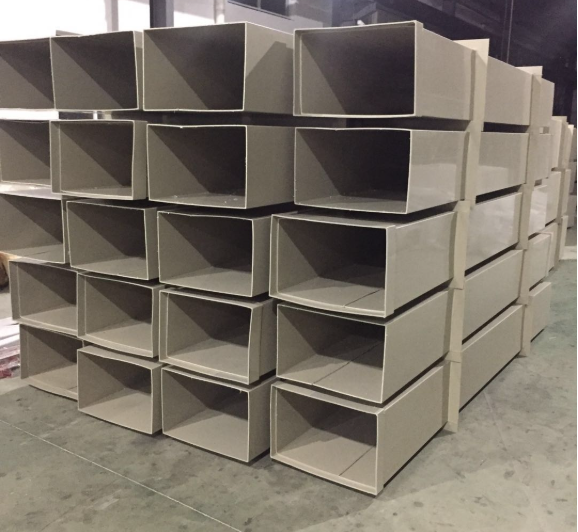
In the installation process, the sealing treatment is crucial. Regardless of the type of connection, it is important to ensure that the sealing material is used correctly. Commonly used sealing materials include rubber gaskets and sealants. When selecting the sealing material, it should be determined according to the environment in which the duct is used and the medium to be conveyed. When conveying corrosive gases, chemical-resistant sealing materials should be selected to ensure the durability of the sealing effect.
In addition, the installer needs to pay attention to the installation position and direction of the duct to ensure that it meets the design requirements. Plastic shims with a thickness of 3-5mm should be inserted between the duct and the bracket to minimize friction and vibration. The distance between the brackets is generally 1.5 – 3m, for the side length or diameter greater than 1250mm duct, lifting shall not exceed 2 sections; side length or diameter less than 1250mm duct, combined lifting shall not exceed 3 sections. When handling the duct, it should be carried gently and put down gently to avoid falling and touching to prevent cracks. When lifting vertically, control ropes should be tied to prevent the air duct from swinging and collision and rupture.
(ii) Maintenance
The routine maintenance of PP square duct is relatively simple, mainly including cleaning and inspection. Because of its smooth surface, dust and dirt are not easy to adhere to, so cleaning is very convenient. Regularly wipe the surface of the duct with a damp cloth to keep it clean. For the inside of the duct, you can use professional cleaning tools, such as duct cleaning brushes, vacuum cleaners, etc., to remove accumulated dust and debris to ensure smooth ventilation. In some dusty industrial places, quarterly internal cleaning can meet the requirements.
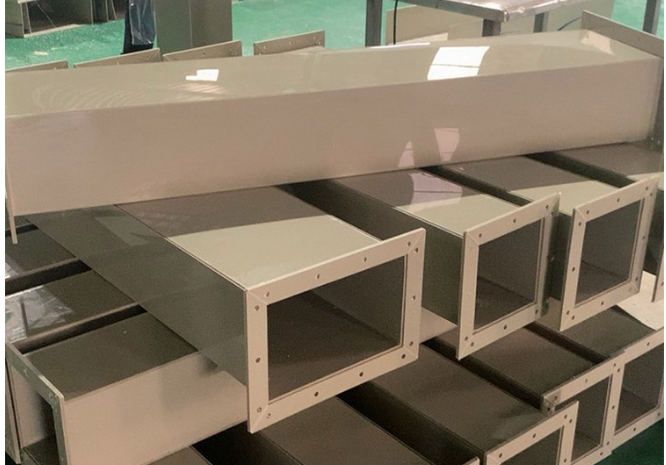
The inspection work is mainly to see whether the connection parts of the air duct are loose, whether there is any leakage phenomenon, and whether there is any damage to the air duct body. Regular inspections can detect potential problems in time and avoid malfunctions. It is generally recommended to conduct a comprehensive inspection every six months. When checking the connection parts, pay attention to see whether the bolts are tight, and whether the sealing gasket is aging or damaged. If problems are found, they should be repaired or replaced in time. For damage to the duct body, small cracks can be repaired with special repair materials, while larger damage requires replacement of the damaged section.
The stability of PP material makes PP square ducts have low maintenance cost. Compared to metal ducts, it does not require corrosion protection and there is no need to worry about rust. Under normal use, PP square ducts are only 30% – 50% less expensive to maintain than metal ducts. And, because of its long service life and low replacement frequency, long-term maintenance costs are further reduced. In commercial buildings, the use of PP square duct ventilation systems can save tens of thousands of dollars in annual maintenance costs.
The maintenance cycle varies according to different use environments and places. In commercial and public places, such as shopping malls, office buildings, etc., it is recommended to carry out a comprehensive maintenance once a year; in industrial places, due to the harsher environment, the maintenance can be carried out once every half a year; the ventilation system of the residential houses is used less frequently and the environment is relatively good, so it is enough to carry out a maintenance once every 2 – 3 years. Of course, if the ventilation system appears obvious odor, air volume decreases or energy consumption increases and other abnormalities, it should be promptly inspected and maintained.